Lesson 130 essay

Jamestown

Before Plymouth Rock, Jamestown was the first colony founded by the English, or more specifically, the London Company. In late 1606, the London Company sent three ships to colonize the American coast. These ships were the “Susan Constant,” “Godspeed,” and “Discovery.” They landed at the mouth of Chesapeake Bay, but sailed inwards about 40 miles on the James River. They then settled there in 1607, and called their new colony, Jamestown.

However, many of Jamestown’s settlers were idle fortune-seekers who did not help in the survival of the colony. Because of this neglect, 2/3 of the colonists died in the first year. In 1608, colonists from Germany and Poland arrived. This is when Captain John Smith took charge of the colony as the third president. He gave out good “laws” based on biblical principles and said things like this; “If any man would not work, neither would he eat.” He helped the colony for some time, but got a wound and had to return to England in 1609. The two years, that he was gone, was nicknamed “The Starving Time” due to the settlers not having a good leader to help them.

Finally a man named John Rolfe arrived with supplies in 1610, and planted tobacco plant. This was harvested in 1614 and the colony had its first profit. Rolfe became wealthy and married Pocahontas, a Native princess. But she got very sick, so Rolfe took her to England in hopes of curing her, but sadly died there.

By 1624, Jamestown could stand on its own feet and no longer needed the London Company. They repaid their debts and became a thriving population, lasting until they joined what later became Virginia, USA.

Jamestown was an excellent example set for the people that started colonizing the coast. Creating a colony and letting it last was easier said than done in the 1600’s but Jamestown is significant because it was the first permanent English settlement in the modern-day United States.

Lesson 125 essay

Queen Elizabeth the 1st of England

Queen Elizabeth I of England was probubly one of the greatest and last of the Tudor Monarchs.

Elizabeth was born 1533 to Anne Boleyn and King Henry VIII. She was raised by several governesses and had a very good education. She could speak several different languages and she was known to have a gentle and good spirit about her.

After Edward VI (Her Half Brother) died, his cousin, Lady Jane Grey, took the throne. But Elizabeth’s half sister, Mary I, who was a catholic unlike Edward, Jane, and Elizabeth, found a way to kill Jane and became Queen. Mary, who hated Elizabeth because she was Protestant, claimed that Elizabeth was plotting to kill her. So, she imprisoned Elizabeth in 1558. But, Mary died and Elizabeth took the throne in 1559.

After she was crowned, the Elizabethan Era came, and it was a flourishing time for England. They became Protestant, Political Problems were solved, they became the top flourishing country, and art and drama came and became an important part of society. She even launched several expeditions around the world.

One of the only problems they had was with Spain though. After Mary’s death, her husband, King Philip of Spain, thought that he should have some consideration of the crown or Elizabeth become his wife. Elizabeth would have none of this so she sent English Ships to invade Spanish ports in the Caribbean. This was a very successful trip but it made Philip furious. This started the Anglo – Spanish war.

Besides the fact that she started a war with Spain, Elizabeth was a very good queen who gave England a new identity. She never married, although she had many suiters, so she was known as “The Virgin Queen”.

But sadly, she started to become very depressed due to some of her dearest friends’ deaths. She eventually died in 1603 and was buried in a shared tomb with Mary I. The country mourned over her death and lovingly called her, “Good Queen Bess”.

Queen Elizabeth I was the last and the greatest of the Tudors. She had a long, prosperous reign that lasted 44 years and brought good times to England, and she will always be remembered.

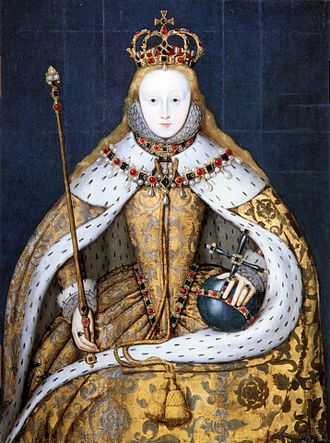
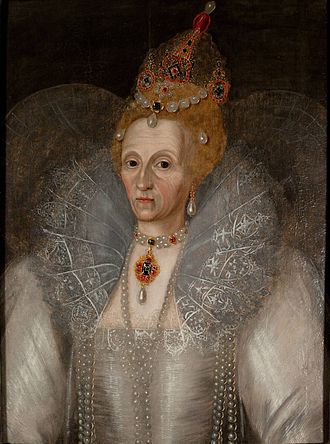
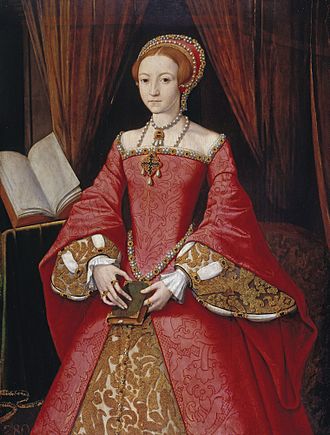
Queen Elizabeth

At her coronation…
She looks a little old in this one…
But young and pretty in this one

Lesson 115 essay

The Catholic Church ruled Europe for a very long time but, in the 16th century, the Protestant Reformation was created by several men who recognized the false teachings of the church. They stood up for their beliefs and some even died for the cause.

On October 31, 1517, a man named Martin Luther nailed the 95 Theses, a disagreement with the Catholic church, to a church door in Wittenberg, Germany. This began the Reformation when a lot of the people in the area were moved by this and started following Luther. They then began teaching things what the Catholic Church did not.

The Reformation started in Germany then spread into other countries such as France, Switzerland, Scotland, England, Italy, Poland, and Sweden. The beliefs of the Reformers were compiled into a list of five Latin phrases:

• Sola scriptura- ‘Scripture alone’
• Sola fide- ‘Faith alone’
• Sola gratia- ‘Grace alone’
• Sola Christus- ‘Through Christ alone’
• Sola Deo gloria- ‘To God alone be the glory’

As you can imagine, the Catholic church was very unhappy to hear of this new movement. So they started to hire people to kill or try “Re-reform” the Reformers. This didnt work well though because the Reformers were strong in their beliefs. Finally, the Reformation ended after a Peace Treaty in 1648.

Lesson 105 essay

Amerigo Vespucci, an Italian explorer who claimed something differently than all the other explorers of his time. What did he claim? Well, he was the first to claim that the New World wasn’t just another part of Asia, but a different continent altogether.

Born in 1454 and raised in Florence, Italy, he was given an education from his uncle, who was a Dominican Friar. He didn’t go to a university like his brothers did, due to the fact that he wasn’t interested in education. Instead, he learned the trade of a merchant. He was then hired by Lorenzo Medici to be a clerk in Venice. His work then took him to Spain, where he had the chance to supply most of Columbus’s journeys to the New World. In 1496, he even had the honor of meeting Columbus himself. After this meeting, Vespucci was inspired to visit the New World himself. So, similar to Prince Henry the Navigator, he wasn’t the chief explorer, but only went on the voyages. Eventually, in 1499, King Manuel I of Portugal, asked Vespucci to come along on several voyages to South America.

Because of these journeys, he was the first to claim that the New World was not part of Asia. This turned out to be true. On his very first voyage, he found that the land went south more than other explorers thought it did . Vespucci had then wrote about his expeditions, and published them.

Martin Waldseemüller was a German cartographer who made the first map of the New World. He was inspired by Vespucci’s book and so, he designed a map of the New World and called the new continents, “North, Central, and South America,” after Amerigo.

Though Italy didn’t establish any oversea colonies, several of the earliest explorers came from Italy. These include; John Cabot, Cristopher Columbus, and Amerigo Vespucci, who all played important roles in the New World explorations.

Lesson 100 essay

After Columbus found other parts of the world, there was many other men, who were mostly Spanish, who decided to follow in his foot steps. One of these was Hernando Cortés.

Cortés was born in 1485 in the Providence of Castile. At the age of fourteen, he went to school to study Latin, all though his classmates thought of him as sickly and mischievous. At the age of sixteen, he heard of Columbus’s discoveries and wanted to become an explorer.

So, in 1504, he joined his first New World expedition that was traveling to Cuba. He then worked in the civil government for many more years. Finally, in 1518, he led his first expedition to explore Mexico. All though he was ordered to cancel the voyage, he ignored the commands and continued. His fleet consisted of eleven ships with about five hundred men. On his arrival, he found many friendly natives, but he had to kill many of them because he wanted to make the land Spanish territory.

There was one problem though; They were greatly outnumbered by the mighty Aztec Empire, so it seemed impossible that his army of five hundred could take down a whole nation. But, by the end, their army consisted of thousands. How? Cortés found many city-states who had owed allegiance to the Aztecs, but actually hated them. He used this to his advantage. Starting from the Mexican coast, he fought his way to the Aztec capital, Tenochtitlán. The Aztec vassals he met, joined forces with him and fought along side. And so, the Aztec emperor, Montezuma was killed by his own men in the fight, leaving no heir to take over. By 1521, Cortés had had control for good.

King Charles I of Spain then appointed Cortés as governor of New Spain. (This region eventually became what we know today as Mexico.) Cortés then rebuilt Tenochtitlán and explored other parts of Mexico. He then voyaged to Honduras, Baja and even California, but sadly died in 1547 on his way back from his exploration.

When his legend reached Spain, it was very quickly exaggerated. Many of the men who went with him were just peasants, but after the Aztec conquest, they gained riches and wealth. Many wanted to follow in Cortés’s footsteps and be successful themselves. But many of the people who tried to follow him, weren’t successful because they were not prepared for the hard work.

Cortés is best remembered for the violent and bloody conquest of the Aztec Empire, but while he was rather headstrong, he wasn’t a cruel governor and ruler. Sadly, those who followed him were repeatedly merciless and often vilified by the people they ruled over.

Lesson 95 essay

Christopher Columbus

Born in 1451 in the Italian city of Genoa, this very famous Italian explorer helped form the path of colonizing, at the time, new parts of the world.
He was born to a wool merchant and when he was still a teenager, he got a job on a merchant ship. He remained at sea until 1470, when French privateers attacked his ship as it sailed north along the Portuguese coast. The boat sank, but he floated along on a scrap of wood and finally arrived in Lisbon. There he studied mathematics, astronomy, cartography and navigation and was very inspired by people like Marco Polo and Ptolemy. This is also where he came up with the plan that would change the world.

Columbus wanted to help free Constantinople from the Muslims and bring the Gospel to China. These two tasks would be very difficult though. First of all, it would be very difficult to get to Constantinople because there was no known rout to get to the city that the Muslims didnt guard. Second, the Silk Road to China was also filled with Muslims. All in all, Columbus’s plans had Muslims in the way, but this didn’t stop him. He wanted to find new paths to get to these destinations, and that path would have to be, west.

At that time, that would have been impossible because everyone believed that the earth was flat, and if you tried to get to china westwards, you would just fall off the edge of the world. Columbus didnt believe this. That is why it was very hard for him to find people to fund his exploration. Everyone thought that it was a waste of time and money.

After trying to negotiate with several people, he tried to ask the Catholic Monarchs of Spain, Ferdinand and Isabella, for funds, but they turned him down. Colobus didnt seem to care and kept trying to get the rulers to fund him. So finally, after two years, the Monarchs agreed to make a deal to fund Colobus’s journey. This deal stated that a portion of the money and items that Christopher collected and earned on his voyage would go to Ferdinand and Isabella’s needs, as well as the needs of their country. Though Spain could have used some more money, Ferdinand and Isabella didn’t really expect Columbus to return, however Columbus had a pretty successful journey and was able to return with impressive news.

Christopher used three ships on his voyages, they were called the Pinta, the Nina, and the Santa Maria, which was the largest ship of these three.

After 5 weeks of sailing, Columbus found an island that he called, San Salvador, as we now know as the Bahamas. The natives who were already living there were very friendly to Columbus and his men and were even willing to trade with them. Something that Columbus noticed was how the people on San Salvador were not open to the technology and weaponry that the rest of the world had. This made Christopher want to teach them about “modern” appliances, religion, etc. Most of the natives there were very eager to learn and discover new things from these travelers, so it was relatively easy for Columbus to get the things he wanted. When he was done there, he left 39 of his men on San Salvador and continued his journey.

Though Christopher had an easy time with the people of San Salvador, the people he met during the last stop of his journey were not pleased with him coming and forcing them to trade with him. This fourth trip certainly did not go as well as the others, mostly because of the violence that was ensued. Lives were lost and villages most likely destroyed.

After four years, there was probably other problems such as, the ships breaking, illnesses on board, and food shortages. These could have been problems that Columbus faced and had to deal with. 

Finally, Christopher Columbus returned to Spain, March of 1493 and died a short time later in the year 1506.

Though Christopher Columbus did some very negative things such as slave trading and using violence to the native people, he was a very interesting man who led an interesting life that will be remembered for many more years to come. And, some what because of him, we live in a country were we can be free and equel.

In 1492, Christopher Columbus sailed the ocean blue.

Lesson 90 essay


The Renaissance period was a time of new development and thinking. It influenced religion, culture, and most famously, art. Some of the greatest artists were from the Renaissance time. These included, Leonardo Da Vinci, Michelangelo, Raphael, Botticelli, Donatello, and Titian. I will be talking about the first two.

Leonardo da Vinci was born in Florence, Italy in 1452. In his early life, he received an informal education, comprising of Latin, geometry, and mathematics and was apprenticed by the artist Verrichio. He was also exposed to different skills such as drawing, painting, and scientific skills like mechanics, chemistry, and metalworking. Because of this, Leonardo was a master in the Guild of St. Luke at the age of twenty. His first known work is a pen and ink drawing of the Arno Valley, while his most famous painting is Mona Lisa, in fact, it is one of the most famous paintings in the world. No one actually knows who the actual model was, but we do know that he spent many years working toward perfection. It now hangs in the Louvre Museum.

He also saw that art and science can be connected. He worked on many scientific and mathematic projects, designed flying machines, studied plants, and was even an architect for a few buildings. When he came up with ideas, he drew them out in great detail, then wrote all his observations and inventions down in a collection of about 13,000 pages.

He died in 1519, remembered as a genius and one of the greatest men of the Renaissance.

Born in Caprise, Italy in 1475, Michelangelo was another great painter and sculpter. He was apprenticed a man who owned the largest workshop in Florence at that time. This happened when he was sent to Florence to study grammar, but he found no interest in it and took up drawing instead. The man we was tutored by was Domenico Ghirlandaio who specialized in painting perspective, portrait, and figure drawing.

Some of Michelangelo’s most famous works include the David statue and the paintings on the ceiling of the Sistine Chapel. Just before his death in 1564, he designed St. Peter’s Basilica in Rome. Sadly, he died before the construction was complete.

These artists preformed incredible work , but didn’t pass their skills on to others. So, when painters and scientists tried to imitate the Renaissance men, no one could copy them. This is what makes the Renaissance men, unique.

Lesson 85 essay

Beginning in the 12th century, the Roman Catholic Church tried to get rid of what they called, heretics. They accomplished this by establishing a group of priests whose job was to find and punish heretics. This group was called the Inquisition.

The purpose of the establishment wasn’t really to help reform the heretical preachers, but to scare others into submission.

Before the Inquisition, the Church would only forbid certain teachings and sometimes imprison them. But with the establishment of the Inquisition, torture and other means of punishment were added to get rid of heretics and their teachings. Generally, the Inquisition would turn the heretics over to the church to await their sentence.

In 1484, the Inquisition even took measures to eliminate “witches” and “wizards.” People began blaming innocent people for poor harvests and bad weather.

Then in 1478, Ferdinand and Isabella of Spain desired to outlaw Islam and Judaism. They did this through the Spanish Inquisition. In 1492, the Spanish Inquisition forced all the Muslims and Jews in Spain to leave the country or convert to Christianity. Some Jews fled from Spain to Portugal and were safe there for a time, but later a Portuguese Inquisition was established. Initiated by the pope, it persecuted the Jews and forced them to convert to Christianity. Instead of only affecting everyone within a certain religion, the Spanish Inquisition affected all conflicting religions to Catholicism.

The Inquisition lasted 7 or 8 centuries, from the 12th to 20th centuries. By the 19th century, the Inquisition was destroyed everywhere outside of the papal states.

Despite the truthfulness to the teachings and questions of the heretics, they were punished, often by death.

John Wycliffe and Jan Huss’ teachings led to the Reformation. Even though the church tried to halt the Reformation, it couldn’t be stopped. The Reformation has shaped the world into what it is today.

Lesson 80 essay

The Black Death

The Black Death was a very deadly plague that killed almost 60% of the English population. It began in 1348 and ended in 1353.

Symptoms of the black death were: Boils, vomiting, fevers and chills. The plague was very contagious and 1 out of 3 people had it and died. When people did die, their bodies were burned but, this made the plague spread even quicker because others breathed in the smoke from the fires.

Doctors in that time were not like the ones we have today. They also didn’t know how what the plague was so, they didnt know how to treat it. They tried very dangerous practices but, this didnt help at all.

Some people had thought that the plague was judgment from the Father so, the did very cruel things to themselves, like whipping themselves in front of everyone thinking that it would make things better but, this made things even worse.

The Black Death had a huge affect on the economy of Europe. For example, men were to weak to plant crops that people started to starve and there was more deaths.

The plague finally died of around 1553 and it took even longer for Europe to go back to normal.

Lesson 75 essay

Joan of Arc

Also known as the Maid of Orleans, Joan was a French hero who fought for French freedom.

Joan was born a peasant girl in a small lovely town. But, when she was twelve years old, she started claiming that there was Saints calling her. She even claimed that she saw them. Finally, she claimed that the angels told her too help retake France for the king.

At first, everyone thought she was crazy and it took her three tries to be able to talk to Charles VII! At this time, Charles wasn’t completely the king of France yet but, he was pretty much considered king. Finally, Charles decided he would talk to her.

She impressed him with her bravery, speech and faith and so, he agreed to let her lead an army to attack the city of Reims. But, before she was allowed to do this, her faith was tested by Catholic priests.

After gathering her army, she rode to the city and retook it! Since Reims was the French coronation city, Joan encouraged Charles to be crowned there, and he did. Thanks to her, the French had a King again!

A while later, she led another army to try to defeat the English but, she was not successful and she was captured by the English. After she was held captive, it was agreed that she should die. And so, she was burned at the stake.

After her death, Joan of Arc became a saint and a famous French hero.